

Tuesday, July 06, 2010

Mr. Magorium


I've heard of this movie, but never seen it. Several times now, though, I've seen the following quote and it makes me want to look this one up.

Mr. Magorium: [to Molly, about dying] When King Lear dies in Act V, do you know what Shakespeare has written? He's written "He dies." That's all, nothing more. No fanfare, no metaphor, no brilliant final words. The culmination of the most influential work of dramatic literature is "He dies." It takes Shakespeare, a genius, to come up with "He dies." And yet every time I read those two words, I find myself overwhelmed with dysphoria. And I know it's only natural to be sad, but not because of the words "He dies." but because of the life we saw prior to the words.

Having no context for this quote within the movie, I'm confused. First of all, "He dies" is a stage direction, and it's the exact same stage direction everybody gets when they die. So there's no significance in that. As for "No brilliant final words", you've chosen a senile old man clutching his daughter's dead body, what exactly did you expect? Go see Hamlet for deep thoughts.

But then Mr. M goes and says exactly what I'm saying when he points out "because of the life we saw prior to those words." Well, yeah, exactly. So....what exactly was your point about the "He dies" thing and the no brilliant last words? Did you want brilliant last words, or did you want a life prior?

So, two questions. First, somebody feel free to explain this quote to me in context. Second, is this a movie that my kids would like? What is it rated, and if it's not G, why (i.e. is it violent, language, etc...)? If it's a kids movie with real people that happens to have Shakespeare in it, I'm all over it.

Shakespeare The Meteorologist

As we sit here in the northeast part of the country trying to stay out of the 100degree temperatures (that'd be USA, and Fahrenheit, for my international readers ;)) I can't help but be reminded of the lesson I once tried to give my daughter in what Sonnet 18 means. 

Shakespeare wonders whether comparing someone to a summer's day would be nice. After all, people like summer. It's nice outside, you play in the sunshine.  But then again, sometimes summer's not so great.  Sometimes rough winds shake the trees.  And sometimes too hot the eye of heaven shines.  Know what that means?  The eye of heaven? That's the sun - that big eye-looking thing up in the sky.  Sometimes it's just too darned hot.

Kind of like...today.  When Shakespeare said "too hot the eye of Heaven shines", this is exactly the kind of weather he was talking about. 

I would be beyond thrilled if I heard my local weatherman break out a reference like that, but I'm not expecting it. :)

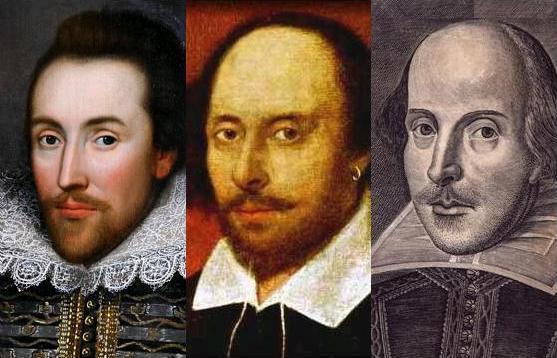
What's Your Favorite Shakespeare Portrait?

This question had me curious over the weekend.  There are many portraits claiming to be Shakespeare - Droeshout, Chandos, Cobbe, Flowers, Jansen, Sanders, etc...    So, two part question:

Image : Cobbe, Chandos, Droeshout

Which one do you like most? Second, Which do you think is likely to be the most accurate?  (I realize that image only combines 3 of many, feel free to make a case for your own favorite even if it's not in there.)

Note, these are not the same question. I happen to use the Chandos for my branding because I get sick of the Droeshout. Whenever I see it I immediately associate that image with generic public domain mass marketing, and that makes me think "Shakespeare at his most shallow."  The Chandos image, whether realistic or not, portrays more of what others have called a "roguish" image.  That's an image that I hope says, "You may think you're familiar with Shakespeare, but there's more there if you care to look deeper."

Droeshout may have the best claim, what with it appearing on the first page of the Folio.  But where did it come from? Was it painted from life, or copied from another source?

I like that the Cobbe is the newest addition to the collection, but honestly I've lost track on its status. I know that some prominent names are backing it (I also know that Professor Stanley Wells, one such prominent figure, may be listening), but last time I looked there were numerous articles that suggested it was not Shakespeare.  Somebody feel free to enlighten me on where we stand.